 A Message From Weiss Ratings Dear Reader, According to Wall Street legend Dr. Martin D. Weiss, there's a $3 trillion disaster in the making in the markets, and it could have a sizable impact on your wealth. "The crisis that's emerging now is just the tip of the iceberg," says Dr. Weiss, who has made shocking and accurate predictions for 55 years, including predicting the Dot-Com collapse and the implosion of Fannie Mae, Bear Stearns and Lehman Brothers in the 2000s. 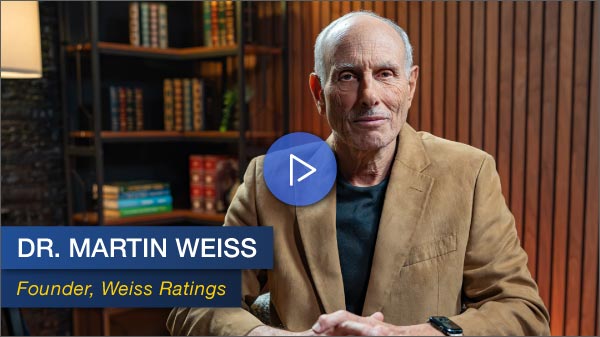
The New York Times has credited Weiss as being "the first to see the dangers." Forbes called him "Mr. Independence." His contributions have been recognized by the U.S. Government Accountability Office. "The biggest danger is not just another stock market crash," he continues. "The biggest danger is not only a major bank failure. Rather, it's a chain reaction of crashes and failures that could cause a global freeze in the financial markets," adds Weiss. The tip of this iceberg? It's already emerging and impacting perhaps thousands of investment accounts across America. Weiss, who has testified in front of Congress, says there are five specific steps every American must consider making with their money, before it's too late. "When the system freezes, nothing works. Virtually everything shuts down. Companies cannot make payroll. Banks cannot meet their daily obligations. Even the Federal Reserve cannot fix it without massive, Herculean efforts." Weiss is doing everything he can to warn the public while there's still time to prepare, including issuing press releases and reaching out to media outlets. In fact, Dr. Weiss has urged us to post a brand-new, urgent warning on our public website … You can access his video message — free of charge — when you click here. Sincerely, Eliza Lasky
Weiss Advocate
Just For You
Broadcom's CEO Sees Years of AI Demand But Warns of a Bigger Threat to the BoomAuthor: Leo Miller. Posted: 10/18/2026. 
Key Points
- Broadcom CEO Hock Tan expects AI computing demand to remain strong for several years, with Intel CEO Lip-Bu Tan expressing similar optimism.
- Hock Tan identified capital availability as a potential constraint on AI growth, even as semiconductor supply shortages begin to ease.
- Broadcom's ambitious AI revenue outlook depends partly on customers such as Anthropic continuing to expand their computing capacity.
- Special Report: 16,783 Americans Were Able to Quit Work with THIS One Form...
Many AI stocks have come under significant pressure in recent weeks, including those in the semiconductor industry. So far in October, the iShares Semiconductor ETF (NASDAQ: SOXX) has fallen approximately 10%. One key contributor to this decline was a report about Anthropic’s third-quarter revenue update. Although its sales increased by a blistering 45% quarter over quarter, a significant slowdown from the previous quarter’s pace raised questions about the sustainability of overall AI growth.
In this context, recent comments from Broadcom’s (NASDAQ: AVGO) CEO Hock Tan are noteworthy, providing both reassurance and reason for caution among investors. Tan expects demand for AI compute to remain strong for several years and believes physical constraints will eventually ease. However, he also highlighted concerns about capital requirements and the importance of generating returns on AI investments. Broadcom and Intel CEOs Point to Strong Compute Demand AheadIn Singapore, Tan spoke at DBS Bank’s Asia Future Forward Conference alongside Intel (NASDAQ: INTC) CEO Lip-Bu Tan. Notably, Hock Tan said that demand for AI compute could continue to exceed supply through 2029, or even 2030, depending on the pace of AI adoption. Lip-Bu Tan made similar comments, noting that Intel does not see demand slowing over the next two to three years. This would create a strong setup for Broadcom, Intel and other companies that supply compute. Additionally, Tan expressed confidence in the industry’s ability to work around physical supply constraints. He noted that the industry has faced numerous bottlenecks over the past two years but has ultimately overcome them. Looking ahead, he said the memory shortage seen today “might not be that way a year from now” and that wafer shortages could ease by 2028 or 2029. This is another positive sign for Broadcom, given that the company says supply constraints are limiting its growth. Despite expecting its AI chip sales to double to $115 billion in fiscal 2027 and double again to $230 billion in 2028, Broadcom said in its last earnings call that demand exceeds these figures. Tan said Broadcom has secured enough supply to meet these forecasts, suggesting potential upside if constraints ease further and customers have sufficient capacity to deploy the chips. Hock Tan Highlights Capital as a Key AI ConstraintOn the other hand, Tan emphasized a nonphysical limitation: capital. “What I think might be the biggest constraint is capital,” he said. Tan was referring to the ability of companies purchasing AI compute to raise sufficient capital to sustain their buildouts. He estimated that companies across the U.S. and China are spending around $200 billion a year on token generation. By comparison, Tan estimated that companies are generating around $150 billion annually in revenue from token generation, concluding, “So AI is underwater, right?” This connects to concerns about the slowdown in Anthropic’s revenue growth as the industry seeks to reverse this imbalance. If companies like Anthropic cannot boost their profits relatively quickly, they will need to seek greater external financing to continue building. This could become increasingly difficult, given that Anthropic is seeking a massive IPO valuation of approximately $2 trillion, which some investors may consider too lofty. Additionally, bond yields have risen significantly in recent months, increasing the cost of debt financing. Tan also noted that the companies currently making much of the money in AI are the “picks and shovels” providers. This includes chip suppliers like Broadcom. However, he said that if the situation remains unchanged, the AI investment trend will not be sustainable. Ultimately, the underlying source of demand for these picks-and-shovels providers is AI model developers, which need to achieve a return on investment to continue spending over the long term. Tan hinted at one pathway through which model developers could generate higher returns on investment: challenging established software providers. Tan said that frontier model developers “will start to disintermediate all the software guys, one by one.” In doing so, value could move up the stack to frontier model developers. While Broadcom is benefiting as a picks-and-shovels provider today, this scenario would also benefit the chipmaker by helping its customers sustain their purchases over the longer term. Hyperscaler Earnings and IPOs Remain Top of Mind for AI InvestorsOverall, while Tan highlighted real concerns regarding the sustainability of the AI buildout, his outlook for compute demand over the next few years remained encouraging. Still, the issues surrounding capital and returns on AI investments are important for investors to monitor. This puts a spotlight not only on upcoming earnings calls from publicly traded AI hyperscalers but also on the financial disclosures surrounding potential Anthropic and OpenAI IPOs. In this regard, although its growth appears to have slowed, it is encouraging that Anthropic reportedly saw its adjusted operating margin exceed 11% in the third quarter. This compares with its previously projected second-quarter adjusted operating margin of 5.1%, suggesting improving profitability, although the comparison is between a reported result and an earlier projection. Continued gains on this front will be key to Anthropic’s ability to sustain chip purchases over the long term. This is particularly relevant to Broadcom, which expects Anthropic to become its largest XPU customer in 2027. . |



0 Comments:
Post a Comment
<< Home