 A Message From TradeWins Ian Cooper here, Before I became a successful trader… I was a struggling journalist facing serious financial pressure. Bills piling up.
Stress mounting.
Running out of time. And like many beginners, I thought options trading was insanely complicated. But during my search for a simpler way to trade… I stumbled onto a straightforward strategy that changed everything. Not because it was flashy. Because it was SIMPLE. Now I’m sharing the details in a free report called: “The Simple Path To Success With Options” Here’s just some of what you’ll discover:
- ✔ The repeatable options trade that changed my life
- ✔ Why simplicity often beats complexity in the market
- ✔ How to copy step-by-step trade blueprints starting tonight
- ✔ The easiest way to get started with options trading
If you’ve ever felt overwhelmed by options… This is the best place to start. Grab your free copy here In your corner, Ian Cooper
Just For You
Ag Equipment’s Recovery Trade Meets Washington’s ScrutinySubmitted by Chris Markoch. Posted: 10/13/2026. 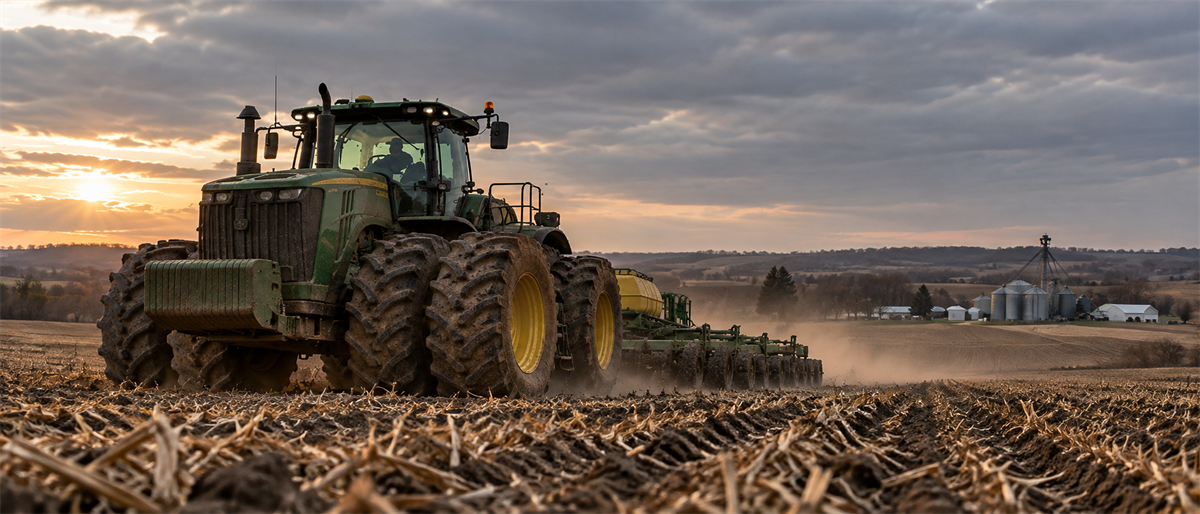
Key Points
- The FTC and USDA launched a joint inquiry on Oct. 7 into potential anticompetitive conduct in agricultural equipment manufacturing and distribution.
- Shares of Deere, AGCO, CNH Industrial, and Caterpillar all fell sharply after the announcement of the inquiry, with AGCO suffering the steepest decline.
- The inquiry is only a request for information with comments due Dec. 7, 2026, so any regulatory action remains uncertain until early 2027.
- Special Report: The AI IPO doubled before the public got a shot
On Oct. 7, the Federal Trade Commission (FTC) and the U.S. Department of Agriculture (USDA) launched a joint public inquiry affecting the agricultural equipment industry. Specifically, the agencies are examining potential anticompetitive conduct in the way equipment is manufactured and distributed. The news sent agricultural equipment stocks plummeting. Deere & Co. (NYSE: DE) dropped 3.8%, AGCO (NYSE: AGCO) fell 6.2%, CNH Industrial (NYSE: CNH) fell 6.1%, and Caterpillar (NYSE: CAT)—one of 2026's strongest stocks—dropped 5.9%.
The inquiry comes as many of these agricultural stocks have begun to recover from a sharp sell-off driven by weak equipment sales. Inflation and higher interest rates have affected the farming community more acutely than other areas of the economy. Deere: The Company Regulators Already Know BestDeere is the company most closely tied to this inquiry. In July, Deere settled with the FTC and five states. It agreed to give farmers and independent shops access to the same diagnostic and repair resources that authorized dealers receive for 10 years, and it paid $1 million toward the states’ legal fees. The order also bars Deere dealers from retaliating against owners or shops that perform their own repairs. That followed a separate $99 million class-action settlement with farmers in April. DE is up approximately 35% in 2026, but that’s not because of demand for agricultural equipment. In the company's Q3 2026 earnings report, it said Production & Precision Ag sales were down approximately 10%, while large-ag industry sales were down 15% to 20% in North America. Instead, Deere has benefited from the broader infrastructure buildout, including artificial intelligence. Its construction and forestry business has become its fastest-growing segment, with customer backlogs extending well into fiscal 2027. Management still considers fiscal 2026 the bottom of the agricultural cycle and expects some recovery in 2027. DE pulled back from a late-September high near $720 and closed below its 50-day simple moving average (SMA) at around $654. The next support level is the 200-day SMA near $593, which aligns with the August lows. As long as the stock holds above that level, the longer-term uptrend remains intact. 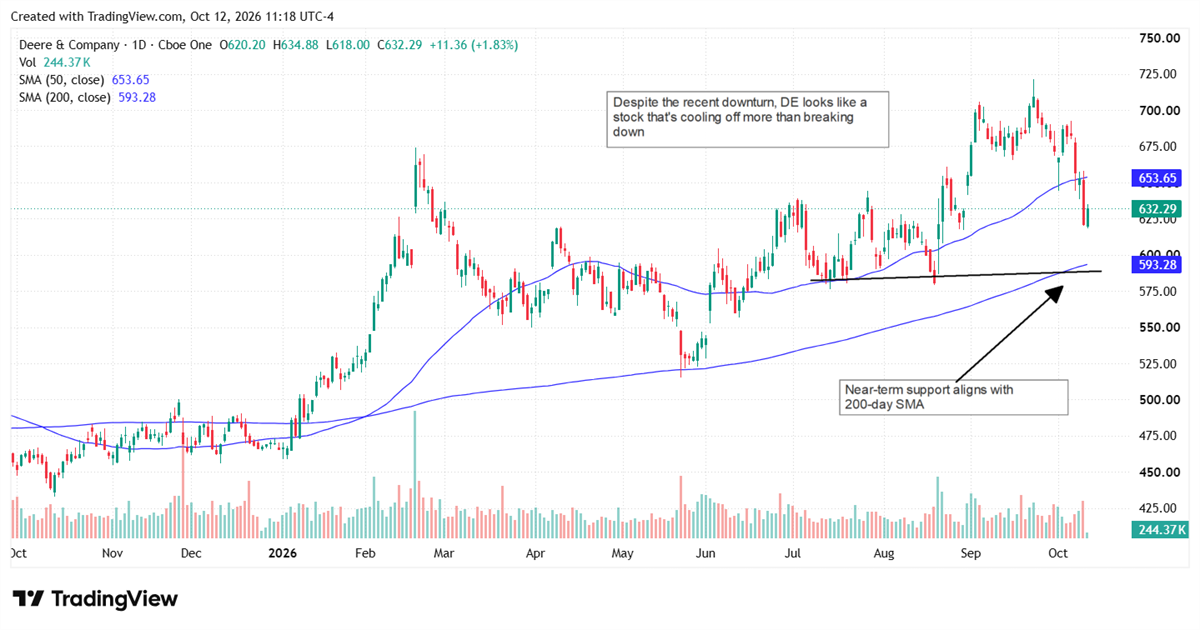
CNH Industrial: A Turnaround Story Under the MicroscopeCNH wasn’t part of the Deere settlement, which is why this inquiry matters to investors. Repair restrictions were specific to Deere’s case. Dealer networks and sales territories are industry-wide issues, so the inquiry could affect how every major manufacturer sells and services its equipment. The timing is awkward because CNH has been one of the market’s favorite recovery stories. In August, CNH beat second-quarter expectations and raised its full-year adjusted earnings per share (EPS) guidance to between 41 cents and 46 cents, up from a range of 35 cents to 45 cents. Shares spiked as much as 15% that day, even though CEO Gerrit Marx described the market as still being at the trough, with North American tractor volumes down 16% to 17%. CNH entered 2026 near $9.35 and now trades around $11.60, a gain of roughly 25%. The stock fell through its 50-day SMA, at about $12.30, following the inquiry news but is holding above its 200-day SMA near $11.20. The 50-day SMA remains well above the 200-day SMA. If the stock falls below $11.20 and closes there, it would suggest September’s run to $14.45 was the high-water mark for now. 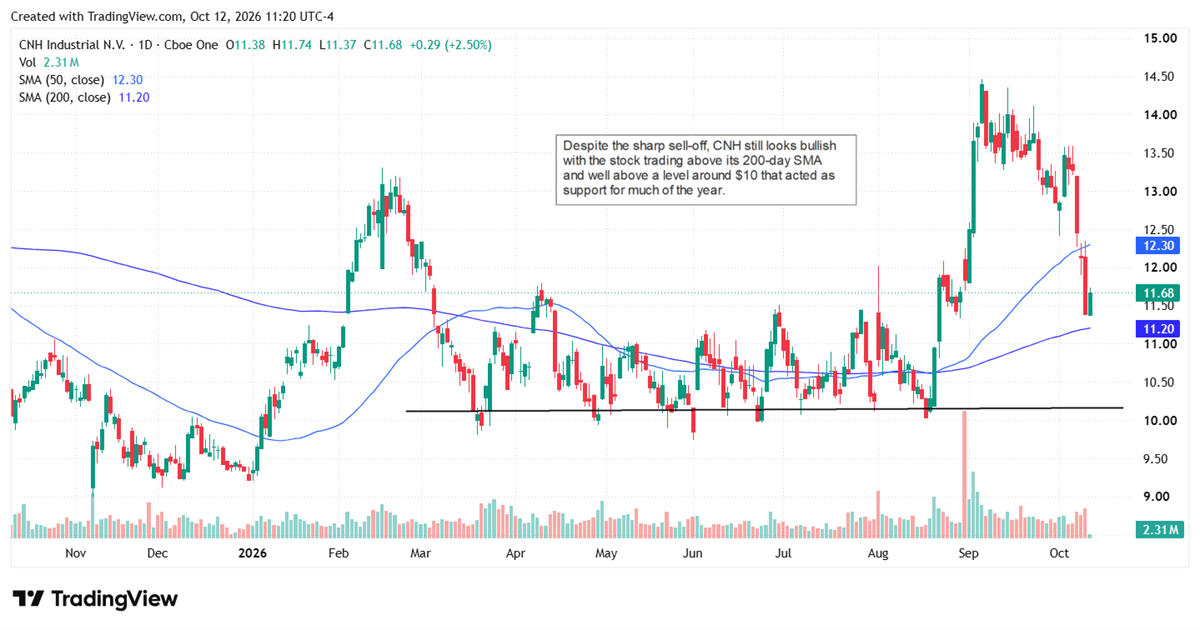
AGCO: The Weakest Hand Going InAGCO took the biggest hit, and that’s no coincidence. It entered the inquiry with the weakest fundamentals of the group. In July, AGCO missed second-quarter estimates and cut its 2026 outlook to net sales of $10.1 billion to $10.2 billion and adjusted EPS of $5.50 to $5.75. What stands out is where AGCO was finding strength. North American sales rose 19.8% in constant currency, driven by high-horsepower tractors and hay tools, while North American pricing ran at roughly 3.5%. Pricing power in the U.S. farm market is exactly the kind of issue an inquiry into equipment costs and dealer practices could put under pressure. When a company’s one bright spot sits in regulators’ crosshairs, the sell-off makes sense. The chart tells the same story. AGCO is roughly flat for 2026. It has given back a February rally that topped $140, and a September bounce stalled near $135. Shares now sit below both the 50-day SMA ($112.96) and the 200-day SMA ($116.50), and the 50-day crossed below the 200-day over the summer. The next support level is around $100, near the August lows. A break below that level would put the stock at new 52-week lows. 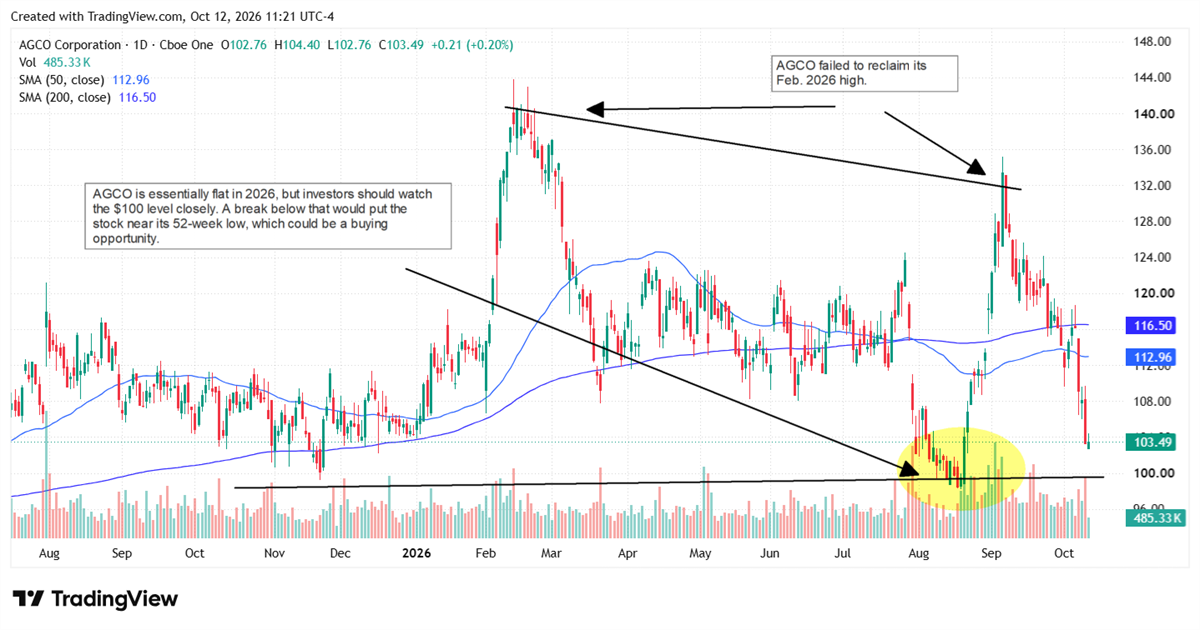
Government Overreach? Not YetIs this a case of government overreach affecting the regular flow of commerce? Probably not, at least not right now. For the moment, this is a request for information (RFI). That doesn't mean the FTC or USDA will act on the data they receive. But investors know all too well that even the most well-meaning government inquiry creates uncertainty. The agriculture industry is one area that doesn't need any more of it. The comment window for the inquiry runs through Dec. 7, 2026. That means any regulatory action won't be known until early 2027 at the earliest. Investors will want to pay close attention to management commentary when these companies report earnings in the coming weeks. . |



0 Comments:
Post a Comment
<< Home