 A Message From The Early Bird Good day, Our research analysts are set to release their next stock idea tomorrow morning just before 12:00 PM Eastern. It will be sent first to investors that sign up to receive the Early Bird Stock of the Day via text, and the next morning to email newsletter subscribers. Don't miss your chance to be the first to see our next stock pick. Our last pick was quite popular with subscribers. This is a free service from The Early Bird and MarketBeat. If you want to take advantage of this unique buying opportunity, simply click the link below to add yourself to our distribution list. Get The Early Bird Stock of the Day The Early Bird Team
Bonus Story from MarketBeat.com
Everyone in AI Is Quietly Copying Palantir's PlaybookSubmitted by Chris Markoch. Posted: 10/1/2026. 
Key Points
- Anthropic is reportedly adopting a founder-control voting structure modeled on Palantir's, granting its CEO and co-founders 50.1% of voting power ahead of a possible IPO.
- Palantir's model-agnostic AIP platform, supporting multiple AI providers rather than one proprietary model, is increasingly being adopted as the enterprise default approach.
- PLTR trades near $188 with a Moderate Buy consensus rating and a $195.33 average price target, as shares approach resistance near the $190 to $200 range.
- Special Report: Red or blue, the record is the same
For years, Palantir Technologies (NASDAQ: PLTR) was the AI stock investors had to explain away. Its founders held outsized voting control. Its CEO sounded more like a philosopher than a salesman. And the company refused to build its own frontier model. The market treated these traits as quirks, while some investors called them red flags. That perception is shifting fast. Within a week, the rest of the AI industry began to look a lot like Palantir. The governance structure that critics once mocked is being copied, while the model-agnostic stance once viewed as a weakness is becoming the enterprise default.
Investors still value Palantir as a high-multiple software story. The bigger story may be that Palantir wrote the operating manual everyone else is now following. The Week the Playbook Went MainstreamOn Sept. 17, Alex Karp appeared on CNBC's "Squawk on the Street." He argued that civil and criminal liability, rather than new regulation, is the first line of defense against dangerous AI. Then he went further, suggesting that leading labs may need to be nationalized because otherwise every one of his clients would sue. Read closely, Karp wasn't endorsing a government takeover. He was accusing frontier labs, including Anthropic, of using the risks posed by their own technology to argue that governments, rather than courts, should absorb the fallout. Yes, it was a jab. Karp will be accused of talking his book. But it highlighted a question the market has barely priced in: Who controls these companies, and who pays when things go wrong? A week later, one lab offered an answer. On Sept. 24, The Information reported that Anthropic is asking shareholders to approve a structure giving CEO Dario Amodei and his six co-founders 50.1% of the voting power. Reuters noted that the design emulates Palantir's founder-control structure. That control would remain in place as long as three of the seven co-founders maintain a minimum stake. The timing is the intriguing story. Anthropic, viewed for months as the enterprise AI leader, is preparing for what could be one of the biggest IPOs on record. Its template for retaining control isn't Alphabet (NASDAQ: GOOGL) or Meta (NASDAQ: META). It's Palantir. Why Founder Control Suddenly Makes SensePalantir's founders hold a fixed block of just under 50% of the voting power, which they retain as long as they collectively hold a minimum number of shares. Governance purists dislike the arrangement because it insulates leadership from activists and short-term shareholder demands. Now consider what AI companies face: mission commitments, national security scrutiny, potential liability for model outcomes and political pressure from every direction. In that environment, a structure that allows founders to say "no" to the market looks less like entrenchment and more like insurance. That's more than a shift in perception. The feature investors once discounted may become one they are asked to accept across the sector. The Neutral Layer Is the Other HalfGovernance is only one half of the story. The other half is Palantir's refusal to pick a model winner. The company's AIP platform supports models from OpenAI, Anthropic, Meta, Google and xAI, as well as self-hosted and customer-provided models. Palantir explicitly calls the platform model-agnostic. Palantir recently opened access to models from Google, Anthropic, DeepSeek, Z.ai and Moonshot AI across several security environments. On Sept. 8, it named Nebius (NASDAQ: NBIS) its preferred sovereign AI infrastructure partner. The goal is to make the model replaceable while keeping the customer's data, permissions and operational structure in place. Customers are saying the quiet part out loud. Stagwell's chief AI officer said the firm wants to remain agnostic to the LLM and switch when a better model arrives. Chamath Palihapitiya expects enterprises to move toward model-agnostic control planes within about 36 months as model costs converge. This isn't the kind of hedging seen at the hyperscalers, where neutrality protects a cloud business. For Palantir, neutrality is the product. If models become commoditized, value moves up the stack. It flows to whoever controls the permissions, governance and audit trail. What the Chart and the Street Are SayingThe market has noticed. PLTR trades near $188, well above its rising 50-day moving average near $167. Shares gapped higher on heavy volume in early August and have made higher lows since. MACD sits just above its signal line, keeping momentum positive. 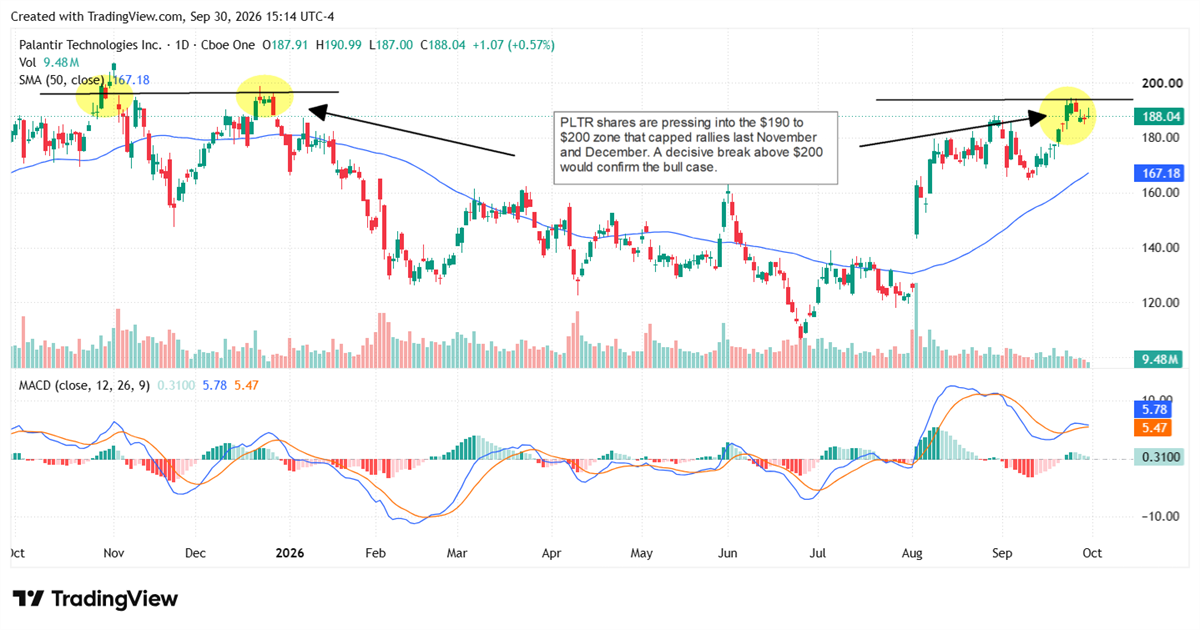
But the setup has a ceiling. Shares are pressing into the $190 to $200 zone that capped rallies last November and December. Volume on this rally is lighter than during the August breakout, while the MACD histogram is flattening. A decisive close above $200 would confirm that the narrative is winning. Another rejection would suggest the market still wants proof. The 36 analysts tracked by MarketBeat give PLTR a consensus Moderate Buy rating with a $195.33 average target, implying about 3% upside. Targets range from $80 to $255. Investor Perception Is Catching Up to Palantir's PlaybookThere's still a sizable contingent of analysts who say Palantir is an expensive software stock led by an eccentric CEO. Industry behavior suggests something different. Its governance model is being borrowed by the enterprise AI leader, while its neutral-layer strategy is becoming the enterprise default. Of course, at these multiples, execution has to remain almost flawless. But investors fixated on price may be missing the bigger signal. When rivals start borrowing your blueprint, the quirks were never quirks. They were the strategy. . |



0 Comments:
Post a Comment
<< Home