
A Message From Weiss Ratings
Dear Reader,
Based on my 55 years of watching the market, I'm deeply concerned that we're in the early stages of a financial crisis that could be larger than the Great Financial Crisis of 2008.
This has very little to do with the national debt, as bad as that is.
Nor is it another debt crisis in the housing market like the one that tanked the markets in 2008.
In fact, it doesn't even involve the "AI bubble" or the high-flying stock market, although major, widely held stocks will almost certainly be among the first to crash.
No, this is something far worse, and even more dangerous.
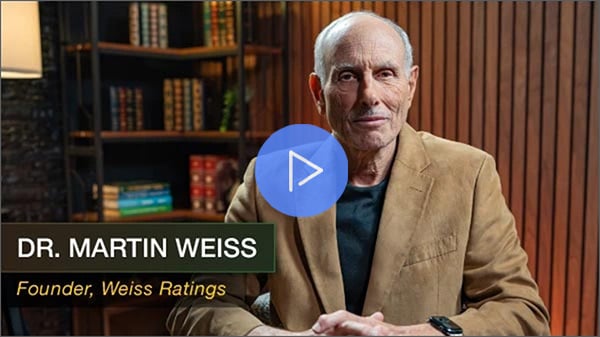
I'm Dr. Martin D. Weiss, New York Times best-selling author, named "Mr. Independence" by Forbes and founder of Weiss Ratings, rated #1 in the Wall Street Journal.
Why #1? Because for 55 years, I have run Weiss Ratings as the nation's only 100% conflict-free, independent financial rating agency in America.
We have never accepted a dime from rated companies for the grades we issue, and we never will. We answer to no one but our members.
Since 1971, when I founded this company, I have publicly predicted six major American crashes before they happened, always naming the companies most likely to fail with ample warning.
And today I'm issuing a public warning about what could be the biggest crisis to ever hit America.
In previous financial crises, many have lost half, or even most of their retirement savings.
My job — and my family's job for nearly one hundred years — has been to give Americans the warning before the warning is too late.
And that's what I'm doing in a free video you can watch today.
>> Go here now to see the most important warning of my career. <<
Good luck and God bless!

Martin D. Weiss, PhD
Weiss Ratings Founder
More Reading from MarketBeat Media
The Fed Is Split on Rates—Why These 2 Treasury ETFs Could Have an Edge
Authored by Nathan Reiff. Originally Published: 11/5/2026.
Key Points
- The Fed held rates steady at its October 2026 meeting, leaving investors uncertain ahead of another decision expected in December.
- TFLO and USFR are floating-rate Treasury ETFs offering yields around 3.71% with low price volatility, though they underperform if the Fed cuts rates.
- Investors seeking a different risk profile might pair these funds with options like VCIT, which offers a higher 5.02% yield but more interest-rate sensitivity.
- Special Report: Inside Your Wallet
The Fed kept the federal funds rate unchanged at its October 2026 meeting, surprising investors who anticipated a shift after a quarter-point rate hike in September. The decision also revealed a divide among policymakers, with two voting members favoring another increase.
With another Fed decision approaching in December, investors face a familiar challenge: earning attractive income without exposing their bond holdings to significant losses if rates rise again.
Two floating-rate Treasury exchange-traded funds (ETFs)—the iShares Treasury Floating Rate Bond ETF (NYSEARCA: TFLO) and the WisdomTree Floating Rate Treasury Fund (NYSEARCA: USFR)—offer a potential solution. Both hold Treasury notes whose interest rates adjust weekly based on short-term bill rates, allowing income to rise when rates increase while helping minimize price volatility.
With low credit risk and competitive yields, these ETFs may offer an appealing alternative to traditional fixed-income funds in the current rate environment.
TFLO: Stable Prices and Treasury-Backed Income
TFLO, which tracks the Bloomberg U.S. Treasury Floating Rate Index, is comprised of just nine holdings.
With an expense ratio of 0.15%, TFLO is not the cheapest fixed-income fund, but its costs are manageable, especially compared with those of the broader ETF market.
TFLO also has more than $7.3 billion in assets under management and healthy trading volume.
Price stability is a crucial feature of TFLO. In 2026, its price has ranged from $50.48 to $50.71—a band of only about half a percent—demonstrating the low volatility that makes floating-rate Treasury ETFs appealing.
Rather than seeking significant price appreciation, TFLO primarily generates returns through income.
In exchange, TFLO provides a yield of 3.71%, with distributions generally taxed as ordinary income.
USFR: Same Strategy, Bigger Fund
Interestingly, USFR tracks the same index as TFLO and also charges an annual fee of 0.15%.
Investors might therefore dismiss these funds as essentially duplicates. However, they have some subtle but important differences.
USFR has about three times TFLO's asset base, with approximately $21.2 billion in assets under management as of Nov. 4, and substantially higher trading volume. Its portfolio also differs in its concentration: USFR holds just five different notes, three of which collectively account for almost 90% of invested assets.
USFR's year-to-date performance is nearly identical to TFLO's, at around 0.2%, and it provides the same 3.71% yield.
With comparable bid-ask spreads and several other similarities, these two funds may be distinguished by their liquidity metrics and holdings. TFLO's somewhat broader portfolio means that any individual maturity matters less. On the other hand, USFR's size and trading volume may suit more active investors or those making larger trades.
What Happens to Floating-Rate ETFs If the Fed Cuts Rates?
Before selecting either fund, investors will want to understand the rules governing Treasury interest passed through by each ETF.
Floating-rate notes also have an important limitation: They offer little protection against falling interest rates. If growth weakens and the Fed decides to reverse course, income from these notes will fall as short-term Treasury bill rates decline. They also cannot capture the price gains that longer bonds could deliver in a similar scenario.
Keep in mind, too, that these notes adjust to Treasury bill rates rather than inflation, so their income may not keep pace with rising consumer prices. A decision to invest in floaters like these may ultimately come down to an investor's convictions about what will happen to interest rates over the coming Fed meetings.
Where TFLO and USFR Fit in a Bond Portfolio
That said, both TFLO and USFR may appeal to investors who anticipate at least one more rate hike from the Fed or an extended period of elevated interest rates and want to limit principal volatility.
These funds can serve as a cash-like core of a bond allocation, which investors could then build out with fixed-income products in other categories. The space has continued to see strong inflows throughout much of the last year.
Still, these funds may be most useful as a place to park money while keeping pace with a hawkish Fed, rather than as a long-term yield play.
Investors seeking to balance that exposure might consider an intermediate-term bond fund with a different risk profile, such as the Vanguard Intermediate-Term Corporate Bond ETF (NASDAQ: VCIT).
With a yield of 5.02% and an average duration of about six years, VCIT can provide higher income potential and the possibility of capital appreciation if interest rates decline.
That could help offset some of the reduced income from floating-rate funds, although VCIT carries greater interest-rate sensitivity and additional corporate credit risk.
. |



0 Comments:
Post a Comment
<< Home