 A Message From TradeSmith Dear Reader, You're probably hearing all kinds of wild rumours about the best way to play AI right now... The SpaceX IPO created 4,400 new millionaires... and OpenAI is reportedly planning its own $1 trillion IPO as early as this fall, which is expected to create even more overnight millionaires... While early holders of Nvidia have had the chance to make millions of dollars on just one stock. (One schoolteacher in New Hampshire retired early after making $2,545,000 on the stock.) MIT says right now is the best time in history to become wealthier, thanks to AI. But the truth is... The best way for ordinary folks to take advantage from what's happening isn't to speculate on AI IPOs... or try to guess which stock will be the "next Nvidia". It's simply to hold these five stocks. Put simply, our system (which is built on an AI platform pioneered by Google) ranks every stock in the S&P 500... And narrows everything down to just five names. There are no complex charts to read. No spending hours in front of a computer screen. No guesswork. All you do is buy five stocks, then hold them for a month. Our backtests show this simple approach could make you 1,000% on your money, without ever ‘holding and hoping' AI stocks themselves. And it could grow your money much faster than the market. For instance, in August you'd have made 4x more money holding just our Top Five Stocks, compared to the S&P 500. That's why I'm trying to share my free demo with as many folks as possible, while there's still time to try this out for yourself. Everything you need to know is here. Regards, Keith Kaplan
CEO, TradeSmith P.S. Sam Altman says AI will be "as essential as electricity" in the future. That's a very grand claim. But it doesn't tell you where your money should be for the best chance to profit and avoid falling behind. That's why I'm urging you to try our new AI tool now and potentially grow your money 10x using just five stocks. Get the full details here.
This ad is sent on behalf of TradeSmith at 1125 N. Charles Street, Baltimore, Maryland 21201. If you’re not interested in this opportunity, please click here.
Exclusive Article from MarketBeat Media
Cologuard Is Working—So Why Isn’t Abbott Stock?Written by Chris Markoch. Date Posted: 10/22/2026. 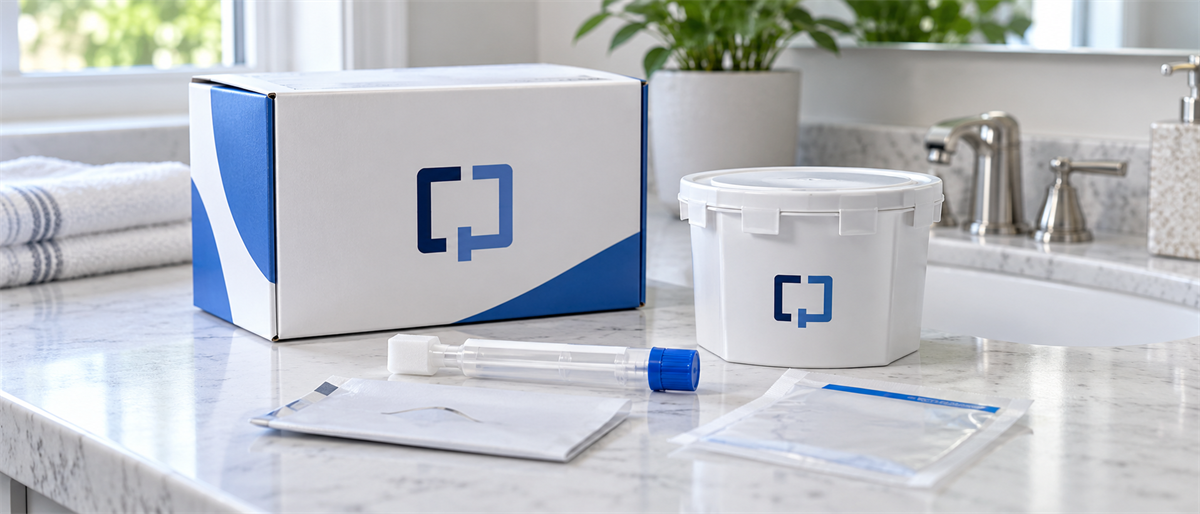
Key Points
- Abbott Laboratories shares fell about 4% after third-quarter results beat revenue expectations but failed to impress investors seeking stronger growth.
- The company announced plans to separate its Nutrition business, home to brands like Similac and Ensure, into an independent public company by the end of 2027.
- Abbott lowered its full-year comparable sales growth outlook to about 6% while narrowing adjusted EPS guidance to a range of $5.50 to $5.55.
- Special Report: What Elon Musk's Cybercab Reveal Could Mean for Investors
Abbott Laboratories (NYSE: ABT) delivered its third-quarter earnings report on Oct. 21. The stock dropped about 4% in early trading as the results were merely solid at a time when investors wanted something spectacular. Revenue of $13.01 billion edged out expectations of $12.99 billion. Sales rose 14.5% on a reported basis, boosted by the Exact Sciences acquisition, and 7% on a comparable basis, which accounts for the acquisition in both periods.
On the bottom line, adjusted earnings per share (EPS) of $1.42 were in line with expectations. Both revenue and EPS, however, were higher year over year (YOY). In Q3 2025, revenue was $11.37 billion and adjusted EPS was $1.30. That works out to 9% earnings growth, and CEO Robert Ford noted that both sales and earnings accelerated compared with the first half of the year. Where the Growth Is Coming FromThis continues a story that began last quarter, when Abbott began to see revenue growth following its acquisition of Exact Sciences. That growth, which included the colon cancer screening tool Cologuard, continued in Q3. However, management was cautious about its guidance for future acceleration, which could be putting pressure on shares. Diagnostics sales jumped 46.7% to $3.31 billion on a reported basis, but rose only 6.4% on a comparable basis. The Cancer Diagnostics segment, which houses the former Exact Sciences businesses, generated $968 million in sales, up 13.8% on a comparable basis. Cologuard led the way, with support from Exact’s precision oncology and international businesses. Medical Devices remained Abbott’s largest segment, with sales of $5.83 billion, up 7.8% on a comparable basis. Electrophysiology grew in the mid-teens, or the high teens when excluding left atrial appendage (LAA) products. Management called this the early stage of a growth-acceleration phase for the business. Why Investors Are Selling the NewsOne reason for the drop in Abbott's stock is that the company's earnings report came on Oct. 21, the morning after SpaceX (NASDAQ: SPCX) delivered a strong earnings report. That sent money flowing back into the technology sector and left blue-chip names like ABT vulnerable to selling. Abbott also used its earnings release to announce plans to separate its Nutrition business into an independent, publicly traded company. That business is home to brands such as Similac, PediaSure, Pedialyte, Glucerna and Ensure. The company says the separation will be structured as a tax-free distribution to shareholders and is expected to be completed by the end of 2027. Over the long term, the move could sharpen Abbott’s focus on medical devices and diagnostics. In the short term, it adds a layer of complexity for investors trying to value the company. But Abbott's earnings report also gave investors more immediate reasons for concern. The company lowered its full-year comparable sales growth outlook to about 6%, down from its prior range of 6.5% to 7.5%, citing headwinds in diabetes care and electrophysiology. Even so, management expects fourth-quarter sales growth to accelerate to just above 8%. Abbott also narrowed its full-year adjusted EPS guidance to $5.50 to $5.55, from $5.45 to $5.60, leaving the midpoint essentially unchanged. However, even at the low end of that guidance, adjusted EPS would be up nearly 7% from $5.15 in 2025. That’s still below the $5.55 to $5.80 range the company issued in January, before dilution from the Exact Sciences deal was factored in. Investors may also be worried that Abbott's 2027 outlook will fall short of expectations, given management's plans to issue conservative guidance in January. ABT Needs to Reclaim Its Moving AveragesLooking at its chart, ABT is range-bound between about $83 and $117. The top of that range is now a well-defined double top. The near-term concern is that the current swing failed well short of it. The 50-day moving average is flattening above a 200-day moving average that’s still sloping downward, so the August golden cross may be close to unwinding. Investors will want to closely watch the 50- and 200-day simple moving averages. If ABT can reclaim those levels on strong volume, a case could be made for a cup-and-handle formation. Until then, the near-term levels to watch are $95–$96, the October low, and $106, where the latest rally was rejected. 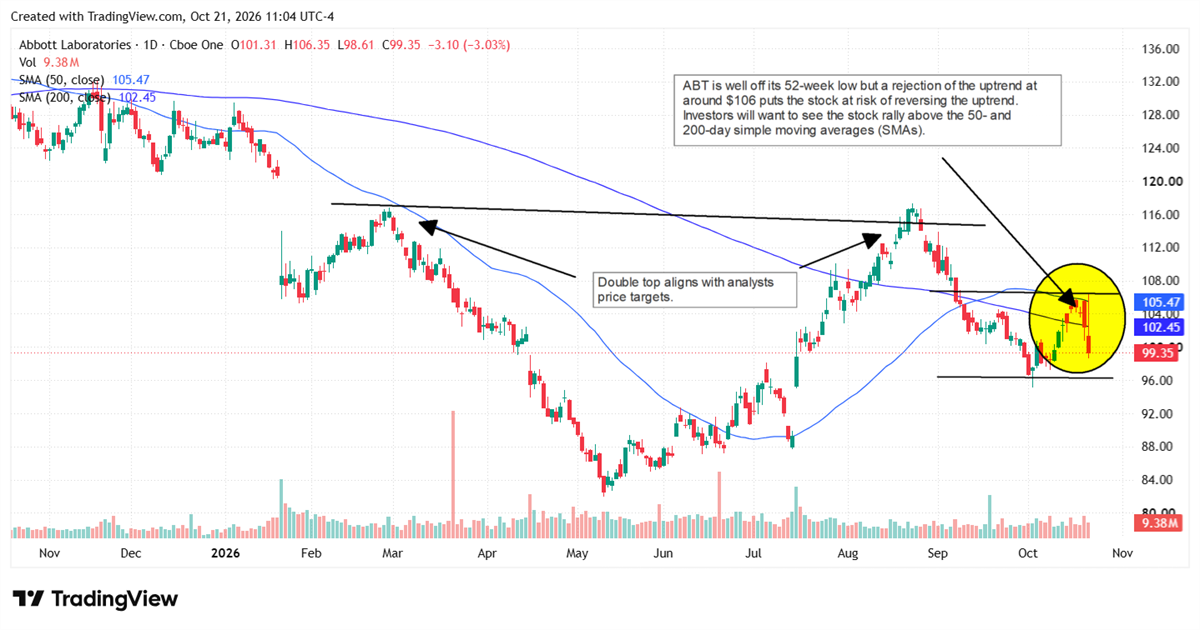
Analysts May Provide the JuiceAs of this writing, the Abbott Labs analyst forecasts on MarketBeat show a consensus price target of $118.88. That implies a gain of about 20% and also aligns with the double top the stock formed in March and August. That 20% gain would be in addition to the stock's dividend, which yields 2.5%. ABT is also a dividend king with a 54-year streak of increasing its dividend payout. The dividend is well supported by the company's projected cash flow. Income investors don’t need to worry about the spinoff, either. Abbott expects the combined dividend paid by Abbott and the new Nutrition company to equal Abbott’s dividend at the time of the separation. . |



0 Comments:
Post a Comment
<< Home