
A Message From Behind the Markets
Dear Friend,
I'm giving you a free stock pick today.
It's not Tesla. It's not SpaceX.
It's the little-known company Elon pays every time he builds anything.
Every Tesla. Every Starlink dish. Every AI satellite he sends up.
Elon doesn't own the chip inside them. He licenses it. From this one company.
And he just filed to launch 1,000,000 satellites.
That could mean a 100X bigger bill.
Dylan believes this stock takes off December 8th.
See today's free stock pick here >>
The Buck Stops Here,
Kelly Maguire
Behind the Markets
P.S. You can own it with a few clicks in any brokerage account. Just don't wait past December 8th.
Get the pick before December 8th here >>
Further Reading from MarketBeat
Bargain Hunting: Why Off-Price Retail Is Winning
By Jeffrey Neal Johnson. Publication Date: 11/22/2026.
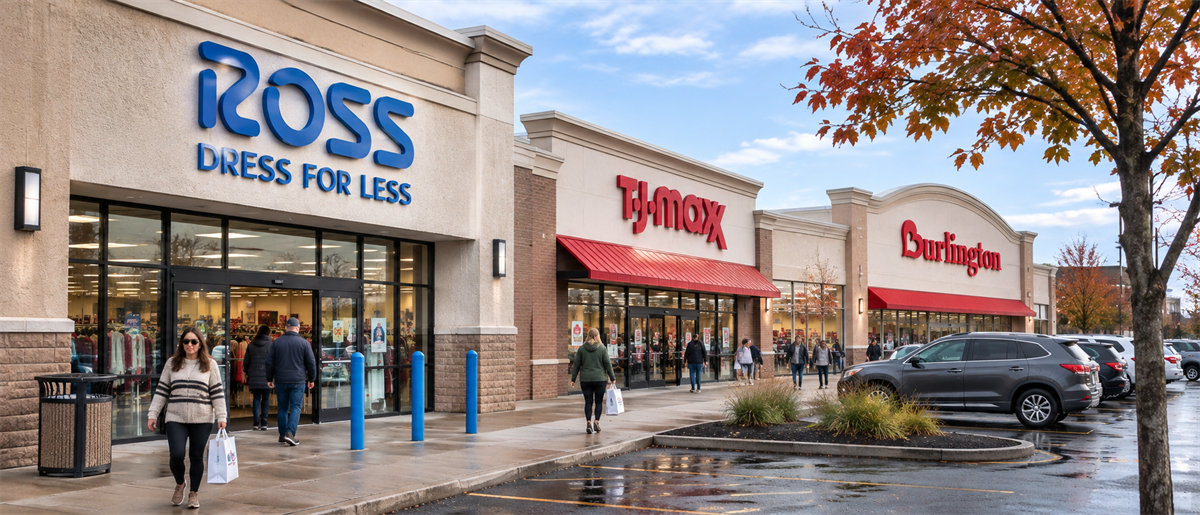
Key Points
- The TJX Companies and Ross Stores both beat revenue expectations in the third quarter, driven primarily by higher customer traffic rather than pricing increases.
- Rising freight and fuel costs are pressuring near-term margins at TJX and Ross Stores, though analysts view the off-price business model as structurally sound.
- Burlington Stores reports third-quarter earnings on Nov. 24, and its lower valuation has made it the top off-price pick for Bank of America and Wells Fargo.
- Special Report: Jensen Huang says this could be 10x bigger than generative AI
Budget-conscious consumers continue to seek out discounted brand names, shifting retail dynamics away from traditional department stores. Off-price retailers offer an appealing alternative, capturing market share through resilient foot traffic and flexible inventory models.
While recent earnings reports from sector leaders show solid revenue growth, elevated freight and fuel costs have created near-term margin pressure. The underlying off-price model remains strong, making upcoming earnings reports a key indicator of relative valuation opportunities.
Ringing the Register: Traffic Growth Fuels the Discount Boom
The ability to acquire excess inventory at a discount and pass those savings on to consumers remains a core strength of the off-price retail model. Recent third-quarter results from The TJX Companies (NYSE: TJX) and Ross Stores (NASDAQ: ROST) highlight the effectiveness of this strategy. Both companies reported strong revenue growth, with Ross Stores citing higher customer traffic as the primary driver of comparable-store sales.
The TJX Companies posted third-quarter revenue of around $15.95 billion, reflecting an approximate 4% increase in comparable-store sales. Similarly, Ross Stores reported about $6.26 billion in revenue, with comparable-store sales up 8%. Ross Stores management noted that customer traffic was the primary growth engine, suggesting that more shoppers are seeking discounted merchandise.
By keeping prices accessible and offering a dynamic shopping experience, these retailers keep the registers ringing. They are turning over inventory efficiently even when the broader macroeconomic picture looks uncertain. The data indicates that off-price retailers are successfully attracting a wider demographic and expanding their customer base beyond traditional core shoppers.
Excess inventory at traditional retailers can allow off-price buyers to step in and secure premium merchandise at steep discounts. This dynamic creates a continuous pipeline of fresh inventory, keeping consumers engaged and driving repeat visits.
Pushing the Cart Uphill: Short-Term Friction in the Supply Chain
Despite strong revenue numbers, both The TJX Companies and Ross Stores issued cautious guidance for the holiday quarter. The off-price model has a recognized structural advantage in inventory sourcing, but external logistics factors, such as higher fuel costs, are currently pressuring profitability.
The TJX Companies reported a slight decline in third-quarter adjusted pre-tax profit margin to about 12.5% and anticipates that fourth-quarter adjusted gross margins could decline by about 50 to 60 basis points year over year. Ross Stores management echoed similar sentiments, pointing to domestic freight and fuel costs as near-term headwinds that could pressure fourth-quarter earnings.
These margin pressures appear tied to external cost factors rather than structural flaws in the business model. To offset them, the companies continue to lean into physical expansion as a long-term growth driver.
Ross Stores successfully executed its 115-store expansion plan for fiscal 2026 and reiterated a long-term goal of about 5% unit growth. A larger physical footprint gives the company more locations through which to sell opportunistically purchased inventory.
For investors, these companies offer defensive capital-return profiles that can provide a cushion during volatile periods. The TJX Companies currently offers a dividend yield of around 1.38%, with a sustainable payout ratio of approximately 35%, and plans to repurchase approximately $3 billion in shares during fiscal 2027. Ross Stores provides a 0.81% yield with a low 21% payout ratio, alongside its own two-year, $2.55 billion buyback authorization. These shareholder-friendly policies help stabilize the investment thesis while management navigates supply chain turbulence.
The Next Aisle Over: Burlington Tests the Valuation Thesis
After The TJX Companies and Ross Stores set the tone for the sector, attention now turns to Burlington Stores (NYSE: BURL). Reporting third-quarter earnings on Nov. 24, Burlington Stores serves as the next critical catalyst for off-price retail investors.
Wall Street analysts are currently divided between chasing momentum and seeking relative value. Firms like Deutsche Bank favor The TJX Companies and Ross Stores for their stronger foot traffic and comparable-sales momentum. Conversely, Bank of America and Wells Fargo designate Burlington Stores as their top off-price pick.
This preference for Burlington Stores centers on valuation and its potential to improve margins. Burlington Stores has experienced a year-to-date pullback of about 15%, creating a distinct relative-value opportunity compared with Ross Stores' approximate 22% year-to-date gain. Trading at a forward price-to-earnings ratio of roughly 19, Burlington Stores is valued at a discount to both The TJX Companies and Ross Stores, whose forward multiples currently hover near 25.
Analysts favoring Burlington Stores point to its valuation and potential for margin improvement, although the company also faces rising freight costs. The upcoming earnings report will clarify whether Burlington Stores can effectively leverage its operational efficiencies to expand margins or whether logistics headwinds are suppressing the entire sector. A positive report could validate the thesis that operational improvements can outpace macroeconomic friction.
Positioning for Retail Resilience
The off-price retail sector demonstrates a proven ability to attract budget-conscious shoppers and capture market share as consumers trade down. While elevated freight and transportation costs are creating margin pressure, the underlying business models remain robust. Defensive attributes, such as steady dividend payments, share repurchases, and ongoing physical store expansions, offer long-term portfolios a layer of stability.
Investors monitoring consumer discretionary stocks might want to watch Burlington Stores' upcoming earnings report. A strong showing could validate the margin-resilience thesis and highlight a compelling mean-reversion candidate. Cautious investors could use this data to decide whether to build positions in the sector's momentum leaders or pivot toward relative-value opportunities as the holiday shopping season unfolds.
. |



0 Comments:
Post a Comment
<< Home