 I spent 25 years at Merrill Lynch and Vanguard watching the same play run, week after week, in every market condition imaginable. Bull markets. Bear markets. The sideways chop that drives every trader crazy. It didn’t matter. The money kept coming in on every trade. Now that I’m on the outside, I’ve put together a free guide that breaks down exactly how this works, in plain English, no jargon, no finance degree required. It’s called the Rapid Retirement Guide, and it covers the simple weekly options technique that institutional desks have used for decades to generate consistent income from the market regardless of direction. What you’ll discover inside: Why most investors looking for retirement income are actually trading on the wrong side of the market... and the simple shift that puts you on equal footing with the "smart money"
- The four principles that guide every trade I make. You’re getting the exact framework I refined over 25 years at Merrill Lynch and Vanguard, in plain English. If you’re playing catch-up, this could shave YEARS off your retirement date!
- The incredible win rate behind this approach. You’ll see why it works more often than not, in up, down, and even sideways markets. And discover how using it could change what you consider a comfortable retirement, for good.
- How weekly options work, along with the pro trading technique quietly used for decades to generate income in every market condition.
All laid out so simply, it could be put in action on your next trade. Click here to get your free copy of the Rapid Retirement Guide. Good Trading,
Dave Aquino
Base Camp Trading
Further Reading from MarketBeat
AMD’s $5 Billion Anthropic Deal Could Redraw the AI Chip BattleWritten by Jeffrey Neal Johnson. First Published: 7/23/2026. 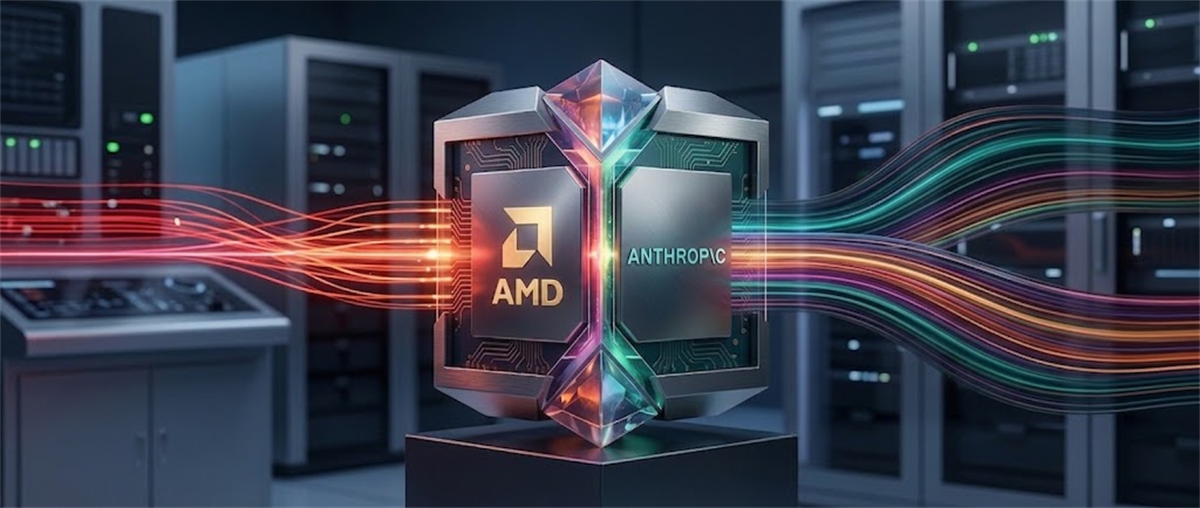
Key Points
- AMD and Anthropic announced a strategic partnership tied to up to 2 gigawatts of AMD Instinct MI450 Series GPUs.
- The deal gives AMD a major frontier AI customer for its Helios rack-scale architecture and strengthens its push beyond piecemeal chip sales.
- AMD’s valuation already reflects high expectations, so execution on Helios, ROCm and 2027 deployment milestones will be critical.
- Special Report: An Overlooked Space Stock Trading Next Door to SpaceX
Advanced Micro Devices (NASDAQ: AMD) is shifting away from piecemeal silicon sales toward a full-stack hardware offensive. Punctuated by a $5 billion equity stake in Anthropic and the immediate rollout of its Helios rack-scale architecture, the strategy positions AMD to secure 2027 capacity commitments from a premier frontier model developer. By executing the agreement without warrants that could dilute shareholders, management is signaling that Advanced Micro Devices can capture structural market share in artificial intelligence (AI) infrastructure from entrenched incumbents.
For institutional and retail investors mapping out the next five years of data center capital expenditures, the hardware landscape is visibly fracturing. Frontier model developers and hyperscalers are actively deploying multichip strategies to diversify supply chains and reduce total cost of ownership. The newly formalized Anthropic partnership serves as a proof of concept for the broader market, signaling that alternative computing ecosystems are ready for enterprise-scale deployment. Electrifying Balance Sheets: The No-Warrant WinThe structure of the $5 billion capital injection into Anthropic reveals deep confidence from Advanced Micro Devices management. Structured as a direct equity investment tied to specific deployment milestones, the agreement notably lacks warrants. In previous capacity agreements negotiated between hyperscalers and frontier artificial intelligence laboratories, warrants were frequently used, eventually leading to equity dilution for hardware providers' shareholders. Avoiding that structure preserves balance sheet integrity and indicates that both entities view Anthropic's underlying valuation as highly defensible. Anthropic will integrate up to two gigawatts of Advanced Micro Devices Instinct MI450 Series GPUs, specifically the MI455X, using the new Helios rack-scale architecture. The initial one-gigawatt capacity is slated for deployment in the first half of 2027. Building a one-gigawatt data center requires billions of dollars in upfront capital, stringent site-readiness standards and extensive power-delivery planning. Procuring enough electricity to run a one-gigawatt site is equivalent to powering a midsized city, often requiring dedicated nuclear or substantial renewable energy infrastructure. Converting a single customer commitment into a multiyear hardware pipeline anchors Advanced Micro Devices' forward earnings projections. The partnership also addresses the most persistent friction point in the semiconductor sector: software integration. Historically, NVIDIA (NASDAQ: NVDA) has maintained an iron grip on developers through its proprietary CUDA software platform. To dismantle that moat, Anthropic is explicitly integrating Claude models to accelerate development of the open-source ROCm software ecosystem. Using advanced natural language processing to debug, optimize and write hardware-level code could automate the software catch-up process, making alternative hardware more accessible to enterprise engineering teams seeking to avoid vendor lock-in. 31 TB of Compute Power UnleashedLive data from the Advancing AI 2026 event in San Francisco provides the technical foundation for these financial commitments. The broader technology market is shifting away from buying individual chips toward procuring fully integrated rack-scale solutions. The newly unveiled Helios architecture directly challenges competing server racks, packing 72 Instinct MI455X GPUs per rack alongside sixth-generation EPYC Venice CPUs and Pensando networking infrastructure. Memory capacity dictates the efficiency of frontier artificial intelligence models. The Helios system delivers up to 31 TB of HBM4 memory, providing a roughly 50% memory-capacity advantage over competing hardware systems. For frontier model inference, memory bandwidth is the primary operational bottleneck. High Bandwidth Memory is one of the most expensive components on a server's bill of materials. Greater memory capacity allows operators to process larger model parameters across fewer racks, substantially lowering total cost of ownership and reducing facility power constraints. Optimizing data-transfer rates could also support higher gross margins over time. Hyperscalers are taking notice of this efficiency gap. Microsoft Corporation (NASDAQ: MSFT) is committed to deploying the Helios Rackscale Solution across Azure data centers beginning in the second half of 2026. By using open-standard networking and avoiding proprietary interconnect lock-ins, data center operators can maintain infrastructure flexibility. This dynamic creates a highly competitive pricing environment, helping ensure that broad enterprise demand remains elevated even as individual chip performance plateaus. Amping Up Forward Estimates and Valuation ModelsThe fundamentals support the aggressive 158% year-to-date run, bringing Advanced Micro Devices' shares near $548 and its market capitalization close to $900 billion. The trailing price-to-earnings ratio is lofty at 181.09, but aggressive forward earnings expectations bring the forward price-to-earnings ratio down to a more digestible 88.37. A price-to-earnings growth ratio of 1.58 balances the steep multiple against anticipated profitability. A PEG ratio of 1.58 for a capital-intensive hardware company is relatively rare, suggesting that the market expects software-like revenue durability over the coming quarters. Wall Street is actively adjusting financial models ahead of the upcoming Aug. 4 earnings report. Management previously guided for $11.2 billion in second-quarter revenue, representing a 46% year-over-year increase. Upward analyst revisions continue to flow in, with institutional desks raising second-quarter earnings-per-share forecasts to $1.47. Sustaining this momentum will require expanding data center margins to offset the cyclical volatility inherent in legacy consumer personal-computing markets. Geopolitical variables and execution risks remain real threats to multiple expansion. Securing longer-term central processing unit deals in China provides a baseline of revenue stability and a necessary buffer against potentially tighter export controls. The board of directors also authorized a $6 billion share repurchase program in May 2025, enabling the reacquisition of up to 3.1% of the outstanding float. Deploying capital for buybacks during a heavy infrastructure build-out signals that Advanced Micro Devices generates enough free cash flow to reward shareholders while continuing to fund robust research and development. Grounding Your Portfolio Before the Next SparkValuations approaching a $1 trillion market capitalization require flawless execution. Any delays in site readiness, power delivery or Helios production milestones ahead of the 2027 deployment targets could trigger severe multiple compression. Investors eyeing the semiconductor sector face a rapidly evolving landscape in which Intel (NASDAQ: INTC) continues to attempt a volatile recovery while the dominant incumbent maintains premium pricing. The strategic alignment with Anthropic, paired with multigigawatt hardware commitments, establishes a durable secondary ecosystem in the artificial intelligence infrastructure space. Those seeking exposure to the physical build-out of frontier compute capacity may want to monitor institutional inflows and margin expansion metrics following the upcoming August earnings release. . |



0 Comments:
Post a Comment
<< Home